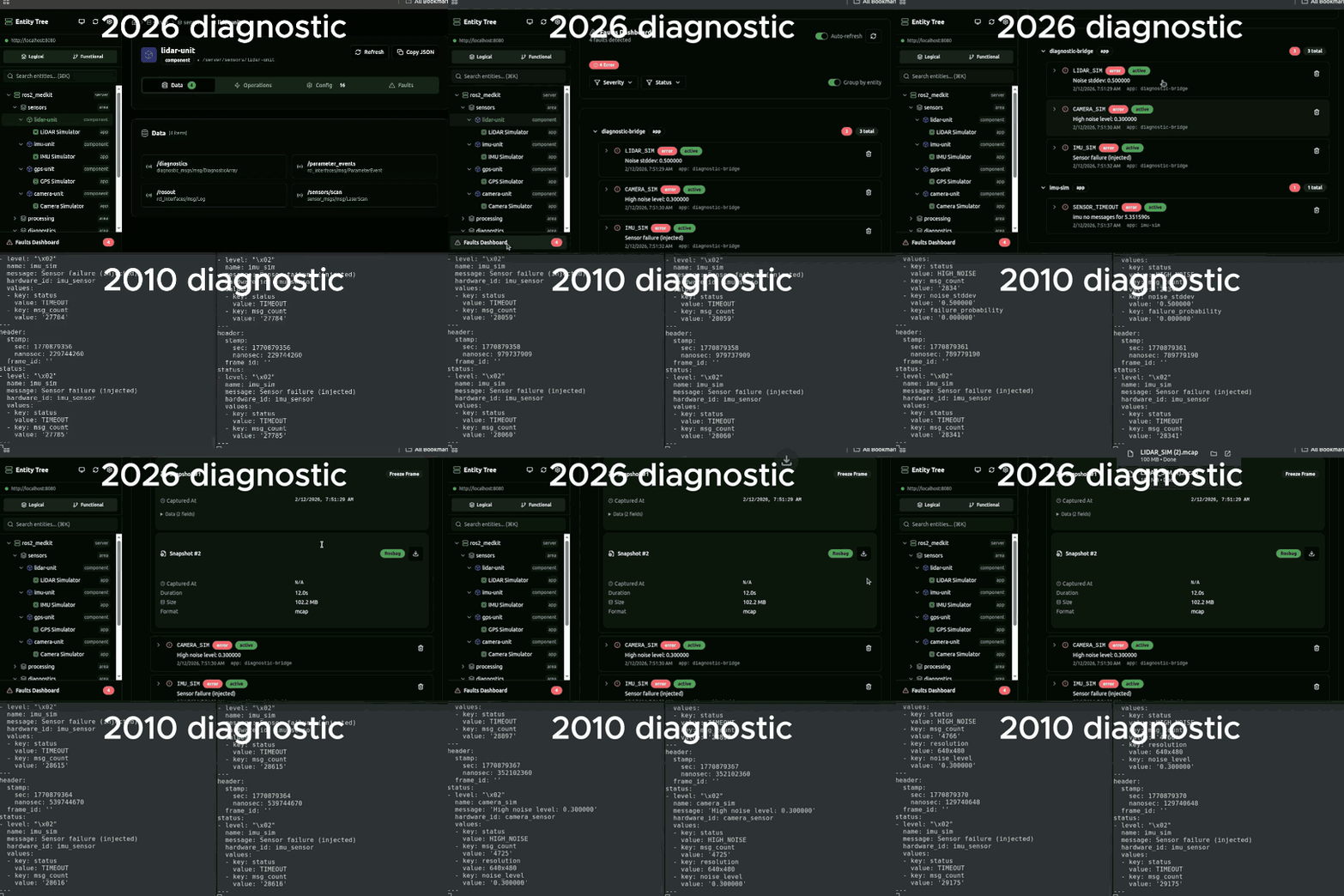
A fault fires at 2 AM. It is gone by the time you SSH in.
That is the defining failure mode of running more than one robot. Not a crash. Not a hardware failure. Just a transient fault that nobody caught because nobody was watching, and by morning, the customer has already called.
ros2_medkit 0.3.0 gave your robot an HTTP interface. Version 0.4.0 gives your fleet the production layer - triggers, remote scripts, resource locking, log aggregation, and a full OpenAPI spec. Six capabilities that replace the SSH-and-pray workflow.
Condition-based triggers
Without medkit: Poll topics in a loop. Write a custom node that watches for thresholds. Hope it survives a restart.
With medkit: One POST request. The trigger persists across restarts via SQLite.
curl -X POST http://robot-01:8080/api/v1/apps/battery_monitor/triggers \
  -H "Content-Type: application/json" \
  -d '{
    "resource": "/api/v1/apps/battery_monitor/data/voltage",
    "trigger_condition": {
      "condition_type": "EnterRange",
      "lower_bound": 0,
      "upper_bound": 22.0
    },
    "multishot": true,
    "persistent": true,
    "lifetime": 86400
  }'
The trigger fires when battery voltage drops below 22V. Set persistent: true and it survives gateway restarts via SQLite. Events stream over SSE at the event_source URI returned in the response.
Tip
Triggers persist in SQLite. Kill the gateway, reboot the robot, restart the container - your rules survive. No cron jobs, no systemd timers, no external state.
Remote diagnostic scripts
Without medkit: scp diagnostic.sh robot-03:/tmp/ && ssh robot-03 'bash /tmp/diagnostic.sh'. No timeout. No audit trail. Hope the script does not hang.
With medkit: Upload, execute, get structured results back. Timeout enforcement and concurrency control included.
# Upload a diagnostic script (multipart form)
curl -X POST http://robot-03:8080/api/v1/apps/lidar_driver/scripts \
  -F "file=@check_lidar_health.sh"

# Execute it
curl -X POST http://robot-03:8080/api/v1/apps/lidar_driver/scripts/check_lidar_health/executions \
  -H "Content-Type: application/json" \
  -d '{"execution_type": "now"}'

# Get execution status
curl http://robot-03:8080/api/v1/apps/lidar_driver/scripts/check_lidar_health/executions/exec_001
{
"id": "exec_001",
"status": "running",
"progress": 50,
"started_at": "2026-03-23T02:14:33Z",
"completed_at": null
}Every execution is tracked with status, progress, and timestamps. The backend is plugin-extensible - swap in a containerized runner, a sandboxed environment, or your own execution engine.
Resource locking
Without medkit: "Hey, are you doing anything on robot 3?" Two engineers change the same config. One overwrites the other. Nobody knows until the robot behaves strangely.
With medkit: Session-tracked, auto-expiring locks on any entity.
# Acquire a lock on the navigation config
curl -X POST http://robot-03:8080/api/v1/components/navigation/locks \
  -H "Content-Type: application/json" \
  -H "X-Client-Id: engineer-alice" \
  -d '{
    "lock_expiration": 300,
    "scopes": ["configurations"]
  }'
{
"id": "lock_1",
"owned": true,
"scopes": ["configurations"],
"lock_expiration": "2026-03-23T02:20:33Z"
}Any mutating operation on a locked entity requires the same X-Client-Id. The lock auto-expires after the TTL, so a dropped session does not leave a resource permanently locked. Scope control via manifest lets you define which entities are lockable and which are always open.
Warning
All mutating operations (parameter writes, config changes, service calls) check the lock state. Attempting to modify a locked entity without the matching X-Client-Id returns a 409 Conflict response.
Log endpoints
Without medkit: journalctl on 4 nodes across 3 namespaces. Or just driving to the site.
With medkit: Two API endpoints. /rosout gives you a ring buffer of recent messages. /logs gives you aggregated logs with area and function-level filtering.
# Logs for a specific component, filtered by severity
curl "http://robot-01:8080/api/v1/apps/nav2_planner/logs?severity=warning"
{
"items": [
{
"timestamp": "2026-03-23T02:14:33Z",
"level": "WARNING",
"message": "Planning failed: start pose outside global costmap bounds",
"logger_name": "/nav2_planner"
}
]
}Logs are per-entity. Query a component and get its logs; query an area and get aggregated logs from all contained components. The log backend is a plugin interface - the default stores a ring buffer in memory from /rosout. Swap in OpenTelemetry, ELK, Loki, or your own pipeline - the REST API stays the same.
Multi-collection SSE
Version 0.3.0 introduced SSE for topic data. Version 0.4.0 extends cyclic subscriptions to stream faults, logs, configurations, and update status through a single event source.
# Create a cyclic subscription on fault data
curl -X POST http://robot-01:8080/api/v1/components/lidar_driver/cyclic-subscriptions \
  -H "Content-Type: application/json" \
  -d '{
    "resource": "/api/v1/components/lidar_driver/faults",
    "interval": "normal",
    "duration": 3600
  }'

# Stream events (SSE)
curl http://robot-01:8080/api/v1/components/lidar_driver/cyclic-subscriptions/sub_001/events
Subscriptions work on any collection: data, faults, configurations, logs, or vendor extensions. One SSE connection per subscription, real-time updates, no polling loops.
OpenAPI 3.1.0
The gateway now serves its own spec at /api/v1/docs with built-in Swagger UI. Named schemas, clean operation IDs, full request/response examples.
# Open the Swagger UI in your browser
open http://robot-01:8080/docs

# Download the OpenAPI spec for client generation
curl http://robot-01:8080/api/v1/docs -o ros2_medkit_api.json

# Generate a typed Python client
openapi-python-client generate --path ros2_medkit_api.json
Every endpoint documented in this article is in the spec. Generate a typed client in Python, TypeScript, Rust, Go - any language with an OpenAPI code generator.
The plugin architecture
All six features share the same extension pattern. ros2_medkit uses a layered merge pipeline for entity discovery, where plugins contribute entities, enrich metadata, and process events.

New in 0.4.0: the pipeline graph analysis plugin (visualizes node connections and data flow), beacon-based entity enrichment (discovers entities via multicast announcements), and Linux process diagnostics (surfaces CPU, memory, and file descriptor metrics for any process as SOVD entities).
Note
Dev setup no longer requires apt. Cross-platform Pixi support means pixi install gets you a working build environment on Linux, macOS, or in CI - no system package manager needed.
The shift
| Pain point | Without medkit | With medkit |
|---|---|---|
| Transient fault at 2 AM | Gone before you SSH in | Trigger fires, webhook delivers, logs captured |
| Running a diagnostic | scp + SSH + manual execution | Upload script, POST /executions, status tracked |
| Config conflicts | "Are you on robot 3?" | X-Client-Id + lock_expiration, 409 if held |
| Reading logs | journalctl across N nodes | /logs API with area/function filtering |
| Building integrations | Reverse-engineer the API | /api/v1/docs serves OpenAPI 3.1 with Swagger UI |
| Monitoring events | One SSE stream for topics only | Cyclic subscriptions on any collection via SSE |
If 0.3.0 was "your robot can talk over HTTP," 0.4.0 is "your fleet can run without firefighting."
Get started
git clone https://github.com/selfpatch/ros2_medkit.git
cd ros2_medkit
pixi install && pixi run build
pixi run start
Open http://localhost:8080/docs for the Swagger UI, or http://localhost:8080/api/v1/docs for the OpenAPI spec. Every endpoint in this article is live and documented.
What this means for operations
Each capability removes a manual step from fleet operations. Triggers replace polling scripts. Remote scripts replace SSH sessions. Locks prevent config conflicts. Logs replace driving to the site. For a fleet scaling beyond a handful of robots, these are the capabilities that let you grow without proportionally growing the on-call team.
Need help adopting medkit in production?
The gateway is open source and ready to deploy. If your fleet needs custom triggers, protocol bridges, or integration consulting - get in touch.
See ros2_medkit in action: bridging VDA 5050 with SOVD diagnostics for AMR fleets, or unifying PLC and ROS 2 diagnostics via OPC-UA.